
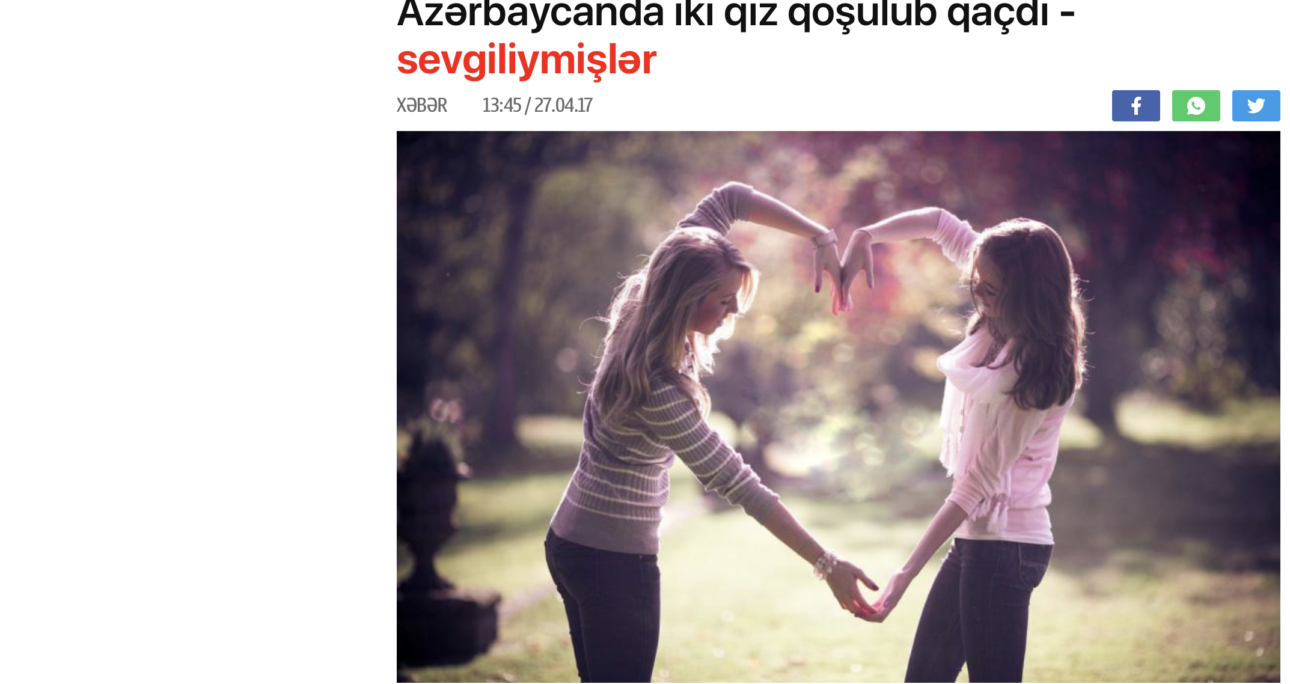
Lesbian Visibility Week is not only about representation — it is about bringing systematically invisibilized lives into the center. In Azerbaijan, this invisibility is not accidental; it is a reality shaped by social pressure, gender roles, and mechanisms of control.
Years ago, in an interview with Azadlıq Radiosu, activist Cavid Nəbiyev voiced a statement that remains sharply relevant today: in Azerbaijan, lesbians are among those who suffer the most.
Lesbian women often face double pressure: both from heteronormative societal expectations and from broader control imposed on women. They are expected to be “modest,” “quiet,” and “family-oriented.” This makes it even more difficult for them to express their desires openly.
As a result, many lesbian women hesitate to form relationships, hide their feelings, or do not live them at all. This is not simply a personal choice — it is behavior shaped by fear.
One of the most painful consequences is forced heterosexual relationships. Lesbian women, under pressure from family and society, enter relationships with men, marry, and create the appearance of a “normal life.” These relationships often continue without their genuine consent or desire.
Such situations lead to emotional exhaustion, psychological violence, and often sexual violence.
The core issue here is that this way of living is not a choice — it is a form of coercion.
Another major challenge lesbian women face is the lack of strong community and support networks. Compared to gay men, their opportunities to find each other are more limited. Due to higher social risks, they tend to isolate themselves more.
This, in turn, intensifies feelings of loneliness, complicates self-acceptance, and makes long-term relationships even harder to build.
Invisibility = vulnerability
Remaining unseen is sometimes chosen as a way to stay safe. But at the same time, it means a lack of protection. Problems that remain invisible are neither recognized legally nor addressed socially.
In Azerbaijan, cases of violence against lesbian women are often not recorded, not spoken about, and ultimately remain unpunished.
This is one of the key factors that allows such violence to continue.
Being visible is not always easy — especially when it carries real risks. But remaining invisible is also, in itself, a form of violence.
This week is not only about acknowledging that lesbians exist, but about speaking openly about the conditions they are forced to live in.